- Orders containing live animals will be shipped Monday/Tuesday/Wednesday (heater included!)
Spirostreptus sp 1 “Tanzania”
Young = 1cm to 4cm Medium-adult = from 4cm
Spirostreptus sp 1 “Tanzania”
(NC)
Kingdom: Animalia
Phylum: Arthropoda
Class: Diplopoda
Order: Spirostreptida
Family: Spirostreptidae
Genus: Spirostreptus
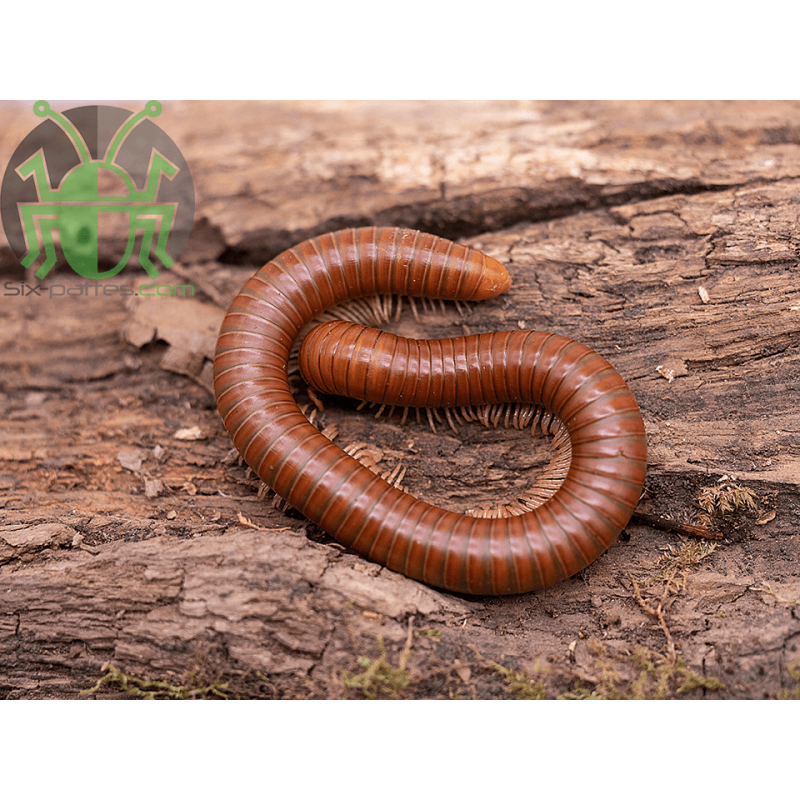
Spirostreptus sp. 1 "Tanzania" is a large millipede that can reach 14 to 15 cm in adulthood, with a diameter close to 8 mm. The dominant coloration is orange-brown with subtle green highlights on the streaks. The name Spirostreptus sp. 1 "Tanzania" is a provisional name used in the terrarium community, as the species has not yet been scientifically described.
Native to Tanzania, it lives in the organically rich soils of tropical rainforests and woodland edges, often buried under leaf litter and rotting dead wood.
Special features:
Very easy to breed
- Species active and visible during the day.
What you might need:
Sprayer
Foam substrate 100g
Calcium carbonate 150g
Analog Thermo-/Hygrometer
Cork bark bag
Digital Thermometer - Hygrometer
Cork bark 30/40cm
Sphagnum moss
Cuttlefish bones
flower beetle /iule/isopod substrate
Natural mousse 200g
Heating cable
Set of 6 multi-purpose precision pliers
01. Breeding
For 3/4 pairs of Spirostreptus sp. 1 "Tanzania" , a terrarium of at least 45 × 45 × 45 cm is recommended. This terrarium can be made of glass or plastic , provided it is poorly ventilated . A humid but slightly ventilated atmosphere is essential for their well-being.
Plastic boxes with a few holes punched in them can also be suitable.
At the bottom of the terrarium, you will need to have at least 20 cm of substrate , which plays a fundamental role: both life support and a source of food for the animals. It is strongly recommended to include pieces of decomposed wood , essential to their diet.
To enrich the environment, we can add:
- bark ,
- foam ,
- dead oak, beech or chestnut leaves , as well as some branches , which will serve as hiding places and increase humidity.
Temperature: Around 20-25°C.
Humidity: 70 - 85% The substrate must remain moist.
Lighting: Sufficient ambient light.
The basic food is the substrate . This is mainly composed of decomposed and crushed leaves and wood of oak, beech or possibly chestnut. We strongly recommend placing pieces of dead wood in the terrarium.
You can add fruits and vegetables, fish food/protein supplement and/or lichen.
Calcium intake is recommended, we will therefore add cuttlefish bone, powdered limestone or reptile calcium as a supplement.
![]()
- Fruits and vegetables must not contain pesticides. It is advisable to rinse them with clean water before use.
- Be careful of mold, you must renew the food as soon as necessary.
Development
2 to 3 years
ADULT LIFESPAN
about 2 years
02. Please note
Sexing: In Spirostreptus sp. 1 “Tanzania”, sexing is done by observing the ventral surface: The male has gonopods (modified legs) located on the 7th segment, clearly visible in adults when observed delicately from below. The female does not have these gonopods; her legs are normal and continuous. Sexing is reliable only from sexual maturity (around 2–3 years).
Prolificacy, mating and egg-laying: Spirostreptus sp. 1 'Tanzania' is considered quite prolific in captivity when conditions are optimal. A mature female can produce several clutches during her lifetime.
Survival of young is highly dependent on substrate richness, humidity, and the absence of predators or disturbances.
Mating in Spirostreptus sp. 1 'Tanzania' takes place in or on the substrate, often at night. The male uses his gonopods to transfer sperm to the female.
The female then lays eggs of about 1 mm , generally buried in the rich substrate.
A clutch can contain up to 150 young . The eggs hatch after a few weeks, and the juveniles remain hidden in the soil for their first few months of life, feeding on the substrate.
Means of defense: Like most millipedes, Spirostreptus sp. 1 “Tanzania” mainly adopts two defensive strategies:
Spirally coiled , thus protecting its vital parts under the hard rings of its exoskeleton.
Secretion of a brownish or yellowish defensive liquid with a strong odor. This liquid contains irritant compounds to discourage predators.
These secretions can stain the skin and give off a lingering odor; it is therefore recommended to wash your hands after handling. However, they are not dangerous if basic precautions are taken and contact with the eyes or mouth is avoided.