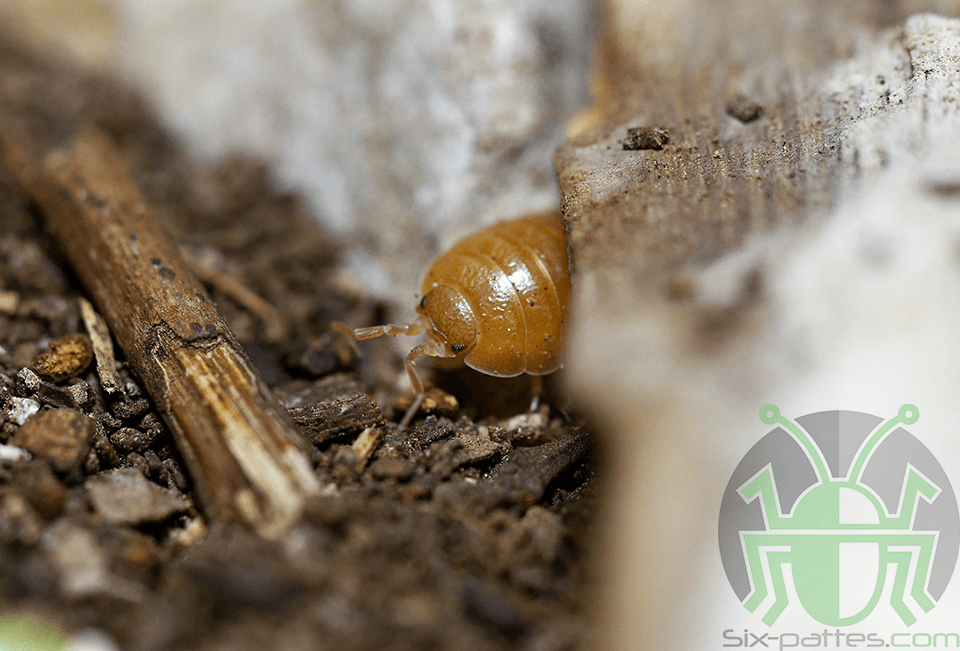
Studies have shown that P. laevis has the ability to tolerate and even accumulate heavy metals in its body. This makes it a potential candidate for bioremediation of soils contaminated with heavy metals. Bioremediation is the use of living organisms to remove pollutants from the environment .
REPRODUCTION and laying
The reproduction of Porcellio laevis “Orange” is very simple.
The incubation of eggs takes place directly in the abdomen of the female in a pouch called a marsupial pouch or marsupium. The eggs and young can be seen through transparency. The young at birth are white and measure about 1mm.
At each laying, about thirty young can be born. There can be 1 to 3 layings per year. They are left with the adults.
TEMPERATURE HYGROMETRY
Temperature
Very robust species, breeding possible from 18 to 28°C .
Hygrometry
50-80%. As with most isopods, it is advisable to separate the terrarium into 2 zones, a humid zone and a dry zone.
If the terrarium is very airy and the substrate dries out too quickly, you can spray a little water.
Terrarium
Terrarium
Many possibilities to raise them. We can use braplast boxes or other plastic boxes with ventilation but also aquariums or terrariums. The size will depend on the number of individuals and will therefore have to be adapted to the growth of the colony. For example, in a 5L box we can keep about 10 individuals. Then in a 10L about 20/30 individuals.
It is possible to create bioactive environments by raising Porcellio laevis “Orange” with other animals.
Substrate
The substrate is a mixture of decomposed oak, beech or chestnut leaves and decomposed wood. This is the litter layer of deciduous forests. The whole will be crushed as finely as possible and then placed at the bottom of the terrarium. An area with whole or coarsely crushed leaves can also be placed.
Decorations and additional elements
Bark will be placed on the substrate to create hiding places. The isopods will gather at this level. We can also add some stones, moss, branches and even natural plants .
Food
Food
They are detritivores and they feed on decomposing organic matter. The basic food will therefore be the substrate . Then we can add pieces of vegetables and fruit . Preferably vegetables and fruits that keep over time and do not go moldy too quickly: zucchini, cucumber, squash, apple, banana, ... It will therefore be necessary to adapt the quantity of food according to the size of your colony.
Supplements
A protein source : dehydrated shrimp are very popular, as is our special isopod mix.
A calcium intake : Cuttlefish bone or calcium powder.