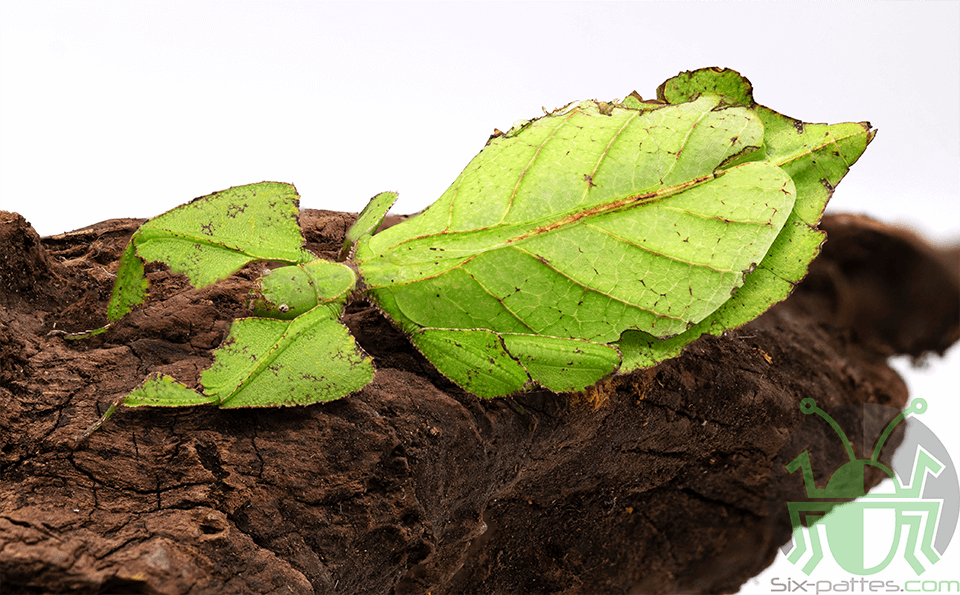
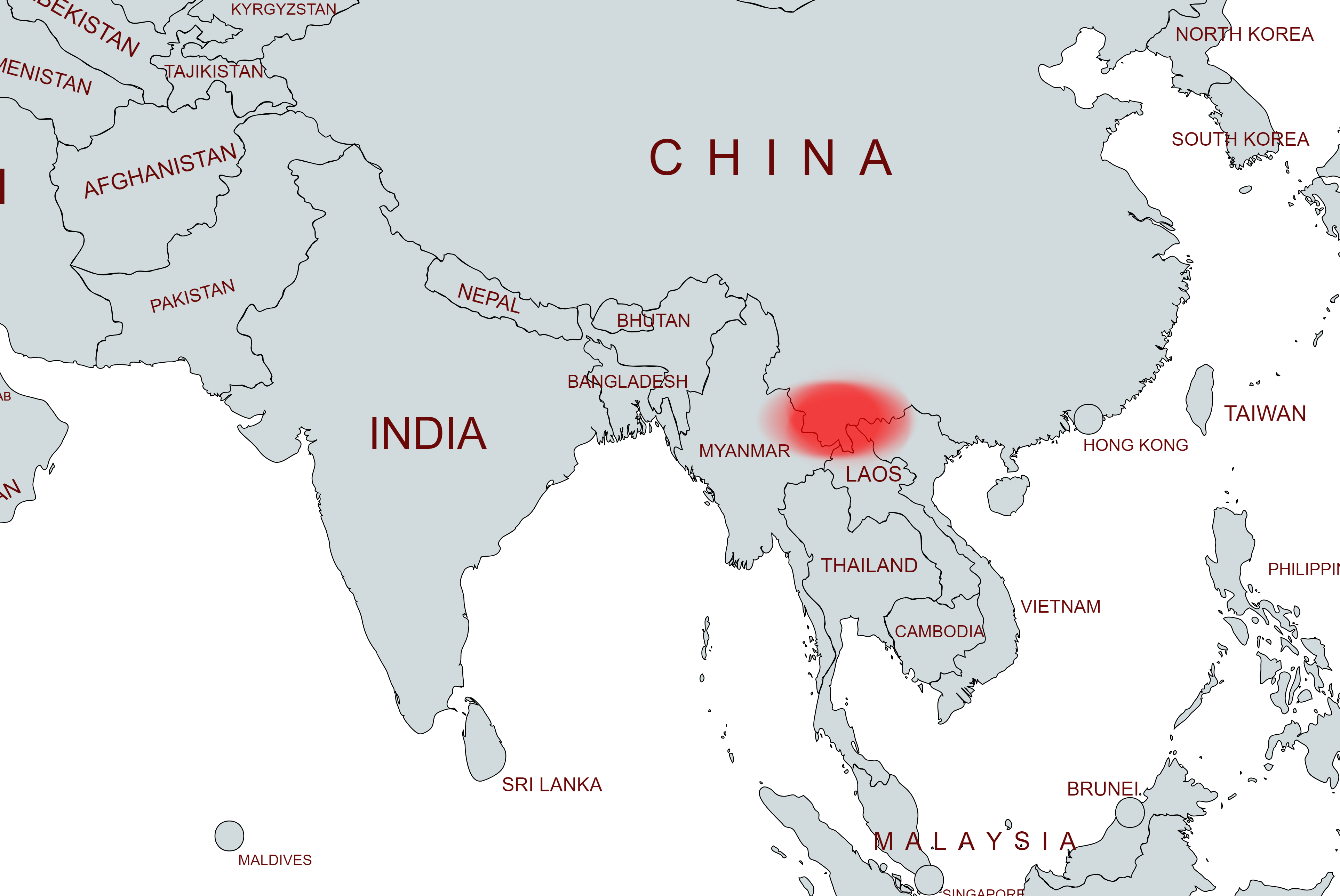
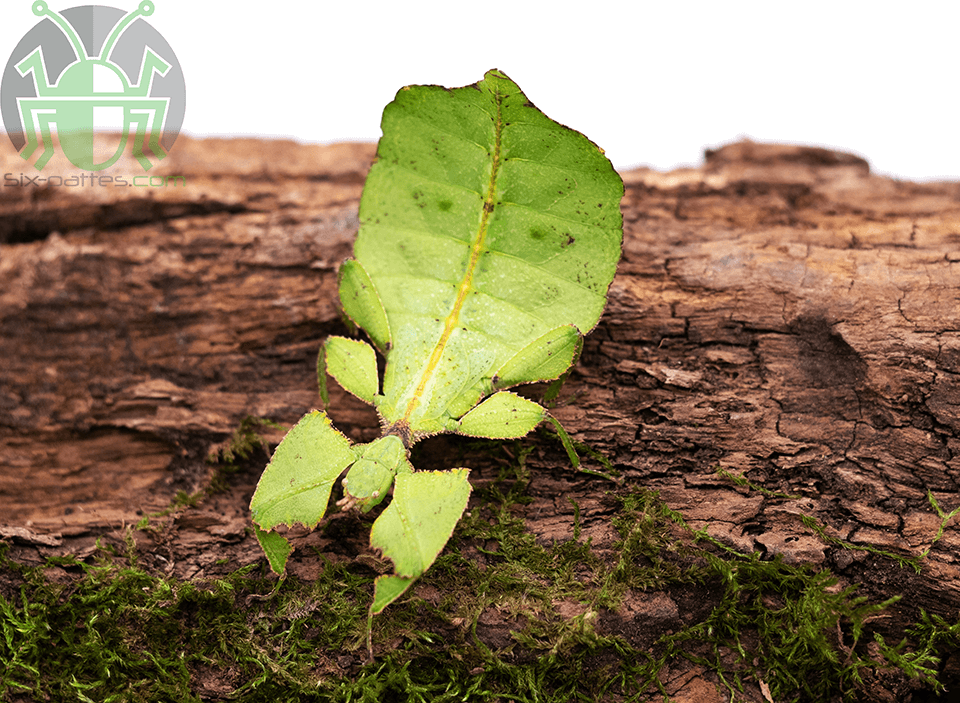
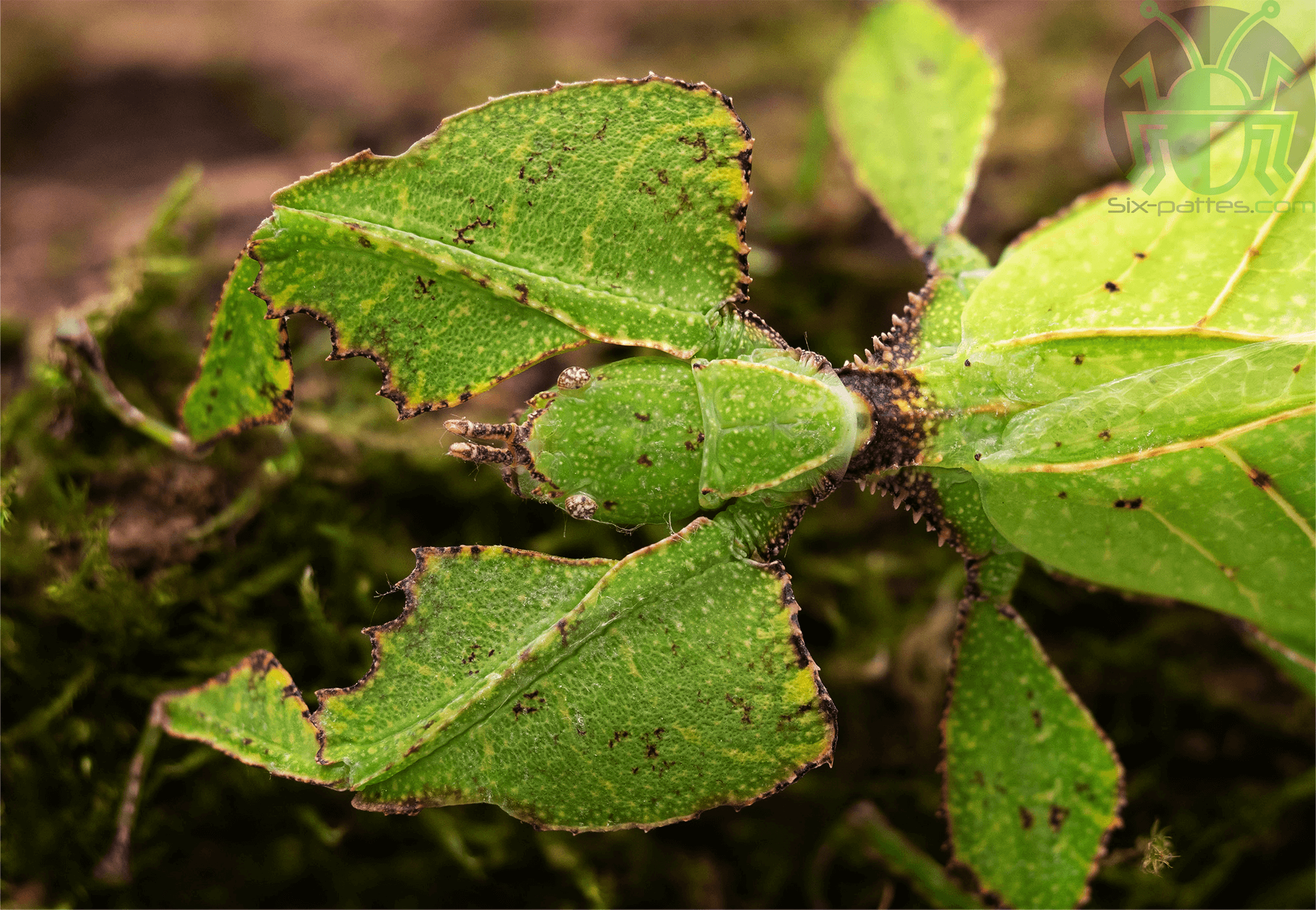
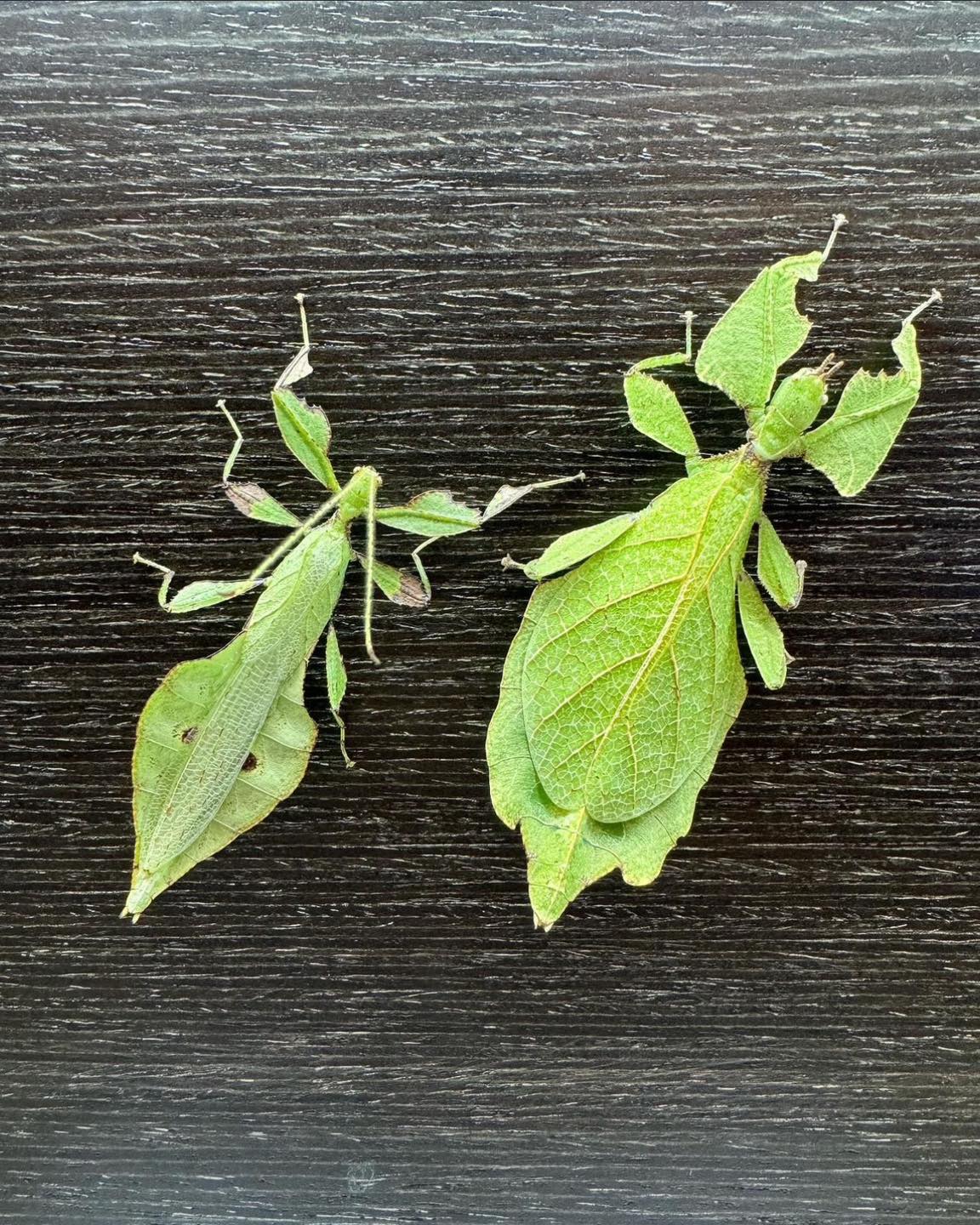
Cryptophyllium sp. "Xishuangbanna"is native to southernYunnan Province in China.It is light green in color and also has veins on its body as well as discreet brown areas. We thus find the same veins as a leaf.
As an adult,the femalemeasures about 10cm and has fixed elytra thatcover almost the entire body. These elytra, similar to wings, do not allow her to fly.
Males are smaller reaching only 6-7cm. They are much thinner andhave fully formed wings that they use to guide themselves if they fall or move away from a threat. They also have long antennae.
The young , when hatched, measure about 1 cm and are brown / reddish-brown in color. They turn green one to two weeks later. Be careful, they can easily lose their legs if they feel threatened or stressed, this is called autotomy. The limbs regenerate little by little when the stick insect moults.
The eggs are about 5 mm in size and have a thick, spongy shell.
Adult female
Special features:
This species is easy to breed compared to other Phyllium. However, it is not recommended for beginners.
Be careful when spraying water on smooth surfaces such as plexiglass or glass because young stick insects can become immobilized by a drop and risk dying stuck to the surface.
Also pay attention to ensuring that the humidity is correct throughout their development.
Place some paper towel at the bottom of the box, moisten it and place the eggs on top. Be careful of the risk of mold.
You place a slice of floral foam at the bottom of the box, moisten it and place the eggs on top.
You place vermiculite at the bottom of the box which you moisten and place the eggs on top.
For young people:
Either you raise them with the adults (be careful when changing food, the young are small and fragile) or you raise them separately. You will therefore have to use the same model of terrarium as the adults but of a smaller size.
The floor of the terrarium will be covered with damp paper towels to maintain good humidity and make it easier to maintain the terrarium.
For adults:
Minimum (recommended) height of the terrarium: 2.5 times the size of the adult female.
The size of the terrarium will depend on the number of specimens. For example, for 3 or 4 specimens, plan for a terrarium of 30cm x 30cm x 45cm for example. It is important to have sufficient height for moulting.
In addition, the terrarium must be partially ventilated . For example, with only one side made of mesh and the others made of glass. This will help maintain sufficient humidity.
The floor of the terrarium will be covered with damp paper towels to maintain good humidity and make it easier to maintain the terrarium.
Mainly bramble. But it is also possible to use holm oak, guava, rosebush and raspberry.
To do this, you need to arrange the branches in the terrarium by placing the stems in a jar of water (to avoid drowning, be sure to block the entrance to the jar with paper towels, for example).
Be careful, it is better to avoid changing food plants during their development.
Renew as soon as the food begins to fade.
For young ones we recommend cutting the ends of the leaves so they can access the tender part of the leaf.
For the eggs:The incubation medium and the atmosphere must remain humid. To do this, spray a little water whenever necessary. Be careful if it is too dry, either there will be no birth, or the young may not be able to come out of the egg completely or will be poorly formed.
For young: Humid atmosphere required, approximately 70/90% humidity. Be careful if it is too dry, the moults will be missed. Humidity can be provided by the food plant thanks to the foliage. Otherwise, you must spray a little water as soon as necessary.
For adults:Humid atmosphere required, about 70/80% humidity. They can tolerate slightly lower humidity. Humidity can be provided by the food plant through the foliage. Otherwise, spray a little water as needed.
Lighting:Lighting is optional if the ambient light is sufficient. Otherwise, additional lighting will be required.
02. Its development
The eggs
Laying method: The female drops her eggs directly onto the ground.
Laying frequency: 1 to 2 eggs per day.
Egg collection: As soon as possible or each time the terrarium is cleaned and the bottom paper towel is changed. It's very simple, you just have to collect the eggs on the ground.
Incubation time: 5 - 8 months. Care must be taken to maintain good humidity and to ensure that there is no development of mold.
The young people
Developmenttime: 5 to 7 months.
Means of defense:Be careful, they can easily lose their legs if they feel threatened or in case of stress, this is called autotomy. The limbs regenerate little by little when the stick insect moults.
Adults
Reproduction: sexual.
Means of defense: --
Activity :--
Lifespan: Lifespan is about 4 to 7 months. Males appear to live shorter lives.