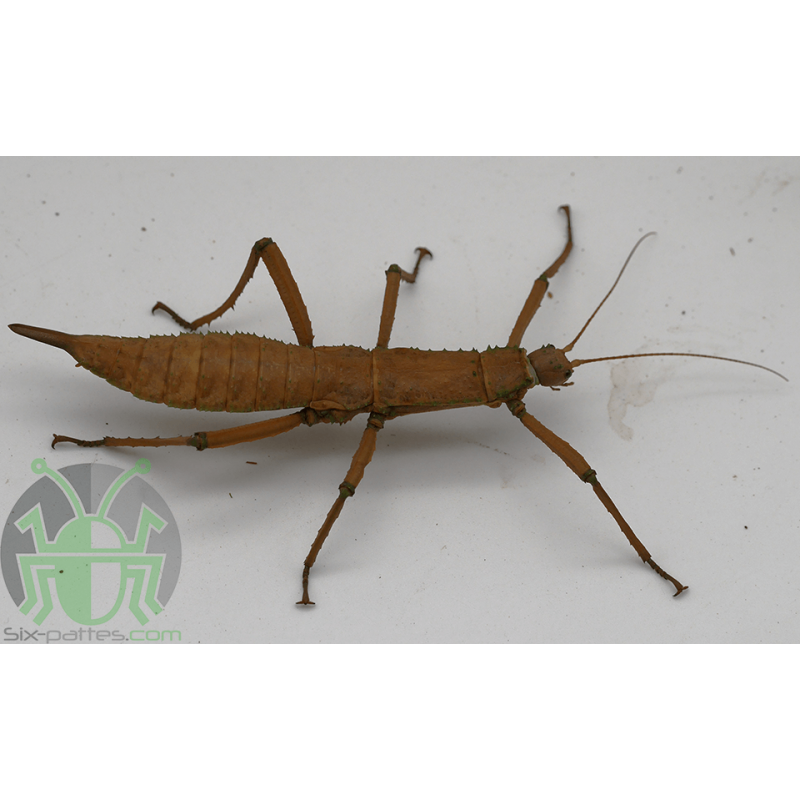
Eurycantha Insularis (or formerly called coriacea) is native to the Solomon Islands and Papua New Guinea.
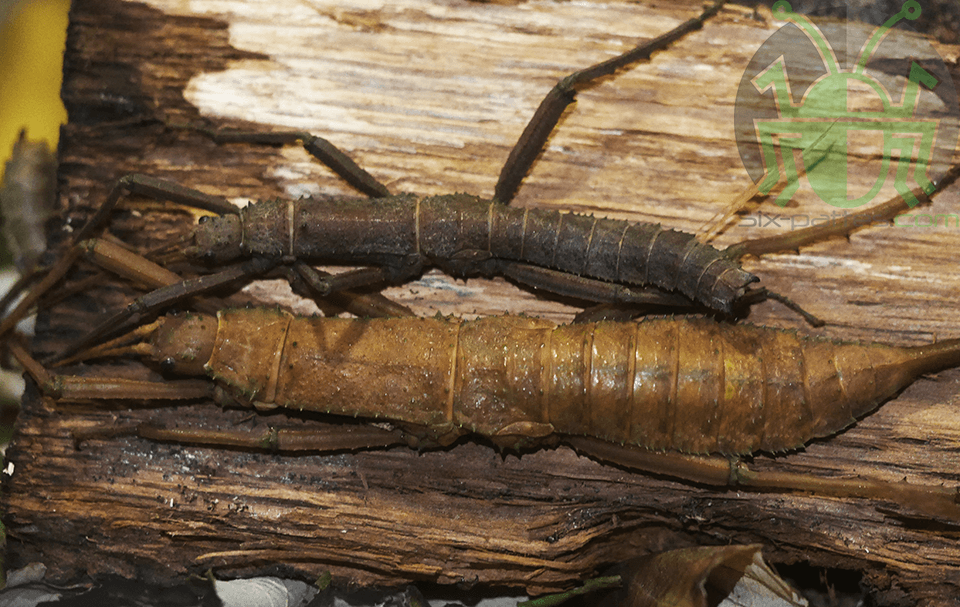
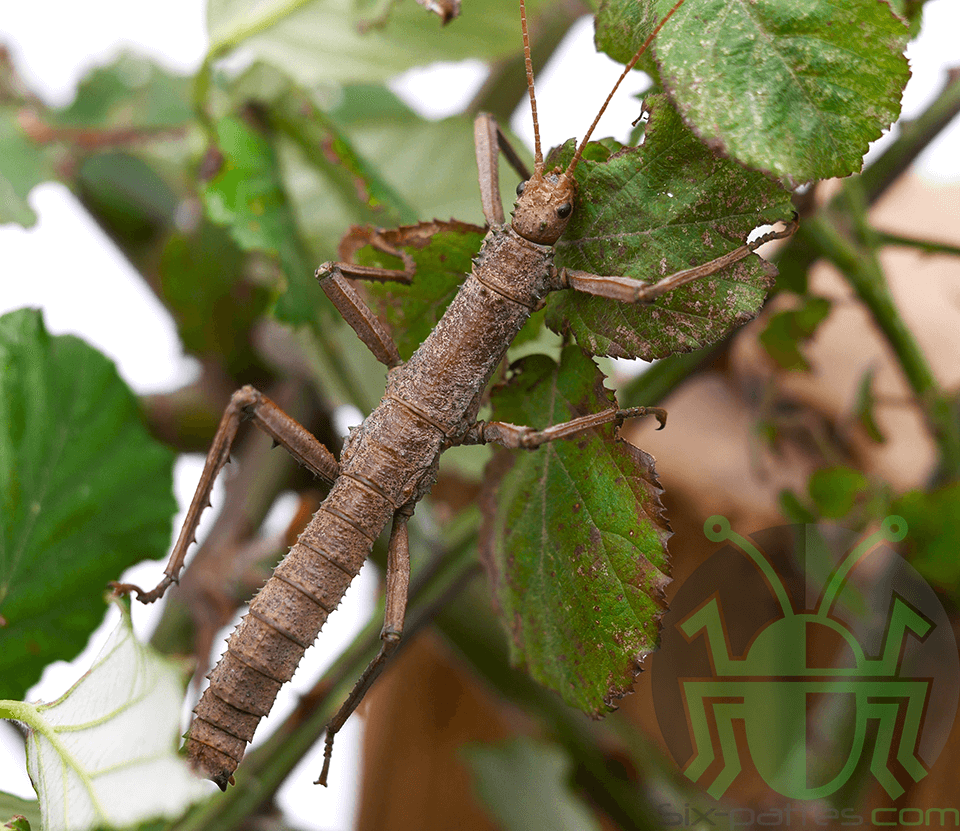
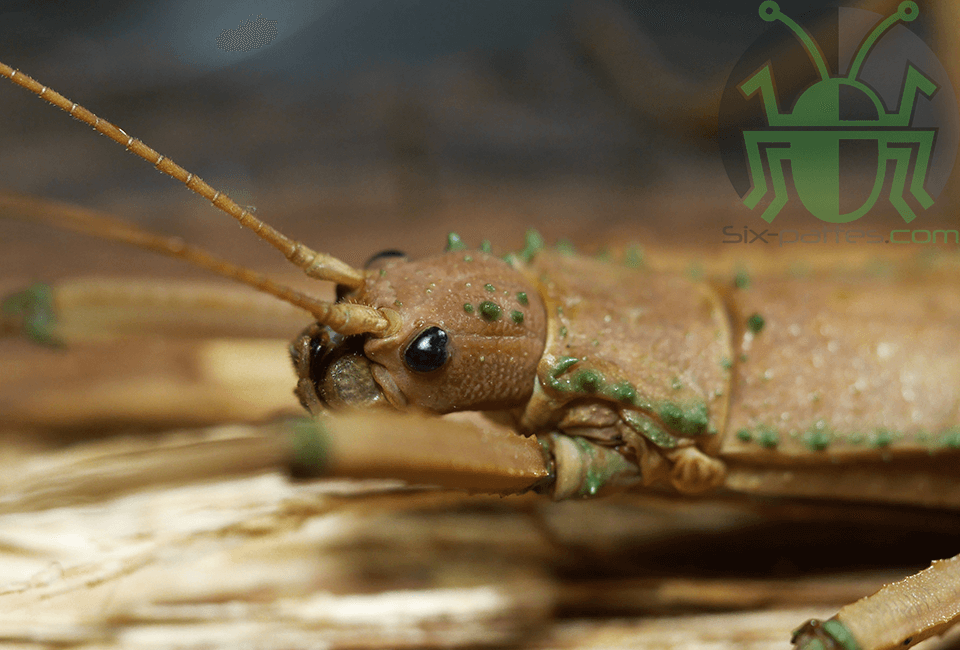
Adult malesare 7-8cm long and are brown/black in color with a rough appearance.They have small spines on their bodies and under their femurs but are much smaller compared to other Eurycantha. They are also much less aggressive.
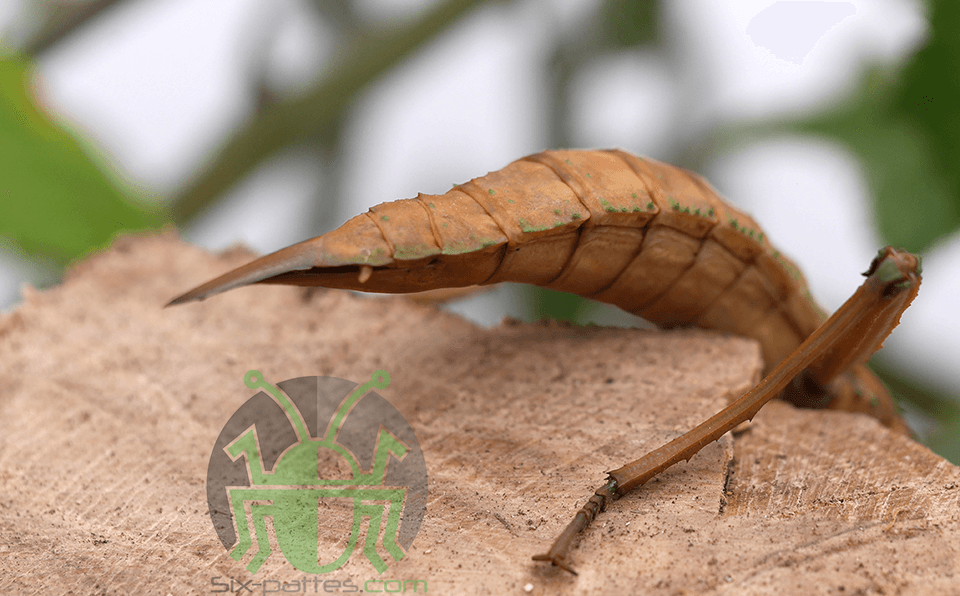
Adult femalesare lighter than males. They measure about 11 to 13 cm andhave a long ovipositor for laying eggs at the end of the abdomen. It also has green spines on the periphery of its body. The female becomes more imposing once fertilized. Indeed, its abdomen dilates and it begins laying eggs.
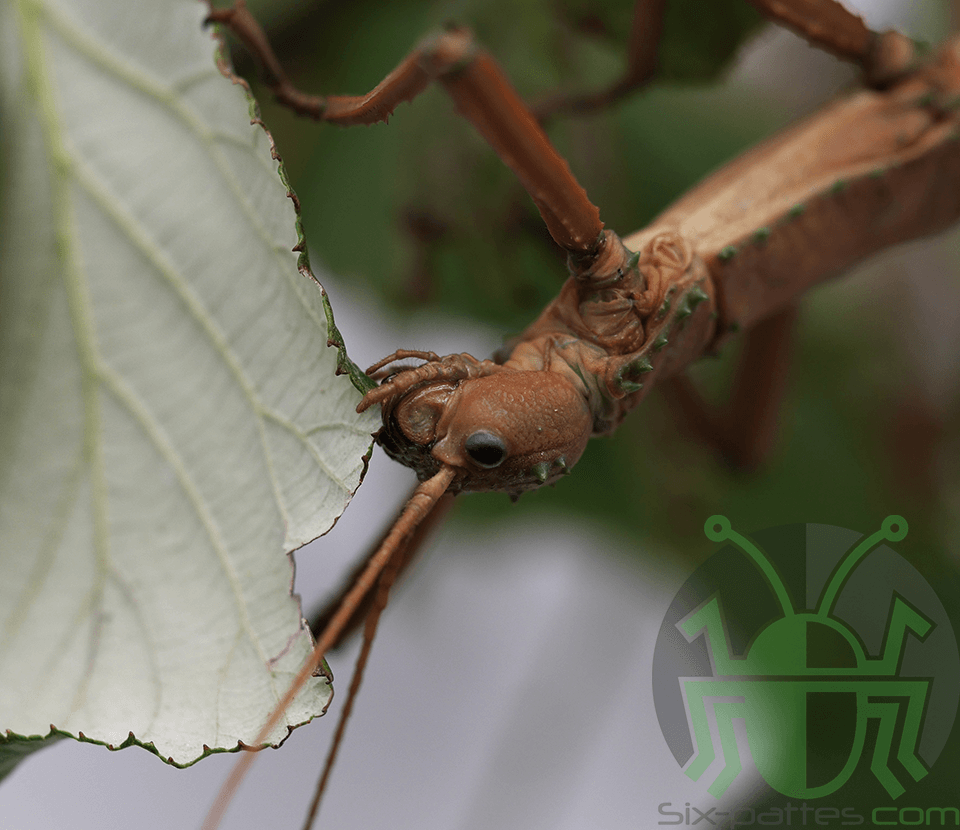
The young measure between 1.5 and 2.5 cm at birth. They are gray / brown in color withmore or less green parts. Then change color during their growth. From the first moult, the first spines appear on the whole body and sexing becomes possible.
The eggs have a porous appearance and are approximately 7mm long and 4mm wide. They are elongated and beige/brown in color with darker edges.
Difficulty of breeding
Very easy
Special features:
Very easy to breed and particularly suitable for beginners
Active at night
Don't forget to add bark, branches, stumps or roots to the terrarium, they will hide there. They often live grouped in the same place.
Place some paper towel at the bottom of the box, moisten it and place the eggs on top. Be careful of the risk of mold.
You place a slice of floral foam at the bottom of the box, moisten it and place the eggs on top.
You place vermiculite at the bottom of the box which you moisten and place the eggs on top.
For young people:
Either you raise them with the adults (be careful when changing food, the young are small and fragile) or you raise them separately. You will therefore have to use the same model of terrarium as the adults but of a smaller size.
The floor of the terrarium will be covered with damp paper towels to maintain good humidity and make it easier to maintain the terrarium.
For adults:
Minimum (recommended) height of the terrarium: 2.5 times the size of the adult female.
The size of the terrarium will depend on the number of specimens. For example, for 3 or 4 specimens, plan a terrarium of 40cm x 40cm x 60cm for example. It is important to have sufficient height for moulting.
In addition, the terrarium must be partially ventilated . For example, with only one side made of mesh and the others made of glass. This will help maintain sufficient humidity.
The floor of the terrarium will be covered with damp paper towels to maintain good humidity and make it easier to maintain the terrarium.
Adults love to hide, so it is highly recommended to have several pieces of bark, branches, roots or stumps.
For the female to lay eggs, a nest box must be provided, i.e. a box with at least 6/7 cm of organic potting soil, vermiculite, peat, sand or a mixture with these elements. A shallow container is therefore required so that the laying substrate is accessible.
It is a very polyphagous species. Mainly bramble. But it is also possible to use oak, rose, raspberry, hazel, ivy, St. John's wort or rhododendron.
To do this, you need to arrange the branches in the terrarium by placing the stems in a jar of water (to avoid drowning, be sure to block the entrance to the jar with paper towels, for example).
Be careful, it is best to avoid changing food plants during their development.
For the eggs:The incubation medium and the atmosphere must remain humid. To do this, spray a little water whenever necessary. Be careful if it is too dry, either there will be no birth, or the young may not be able to fully emerge from the egg or will be poorly formed.
For young: Humid atmosphere required, approximately 70/90% humidity. Be careful if it is too dry, the moults will be missed. Humidity can be provided by the food plant thanks to the foliage. Otherwise, you must spray a little water as soon as necessary.
For adults:Humid atmosphere required, approximately 70/80% humidity. Humidity can be provided by the food plant through the foliage. Otherwise, spray a little water as needed.
Lighting :Lighting is optional if the ambient light is sufficient. Otherwise, additional lighting will be required.
02. Its development
The eggs
Laying method: The female buries her eggs in the nest using her ovipositor. She begins laying about 3 weeks after her last moult.
Frequency of laying: The laying seems to be done in periods. Indeed, as soon as the female becomes an adult, her abdomen is still thin. After a few weeks and after mating, the abdomen will grow and expand until laying. She will lay about 2 to 3 eggs per day. Then it will return to its normal size until the next laying cycle. This is certainly the development time of the eggs in the female's abdomen.
Egg collection:As soon as possible or each time the terrarium is cleaned and the bottom paper towel is changed. It is therefore necessary to search the substrate of the laying nest in order to extract the eggs and then place them in the incubator.
Incubation time: approximately 3 to 5 months. Care must be taken to maintain good humidity and to ensure that no mold develops.
The young people
Developmenttime: 5 to 7 months.
Means of defense:None
Adults
Reproduction: sexual or parthenogenetic.
Defense:Much less aggressive than Eurycantha calcarata.
Activity :Nocturnal stick insect. During the day it hides under bark. At night it moves, feeds and the females lay eggs.
Lifespan: The life span is approximately 6 months to 1 year.



%20(1).png)